William Shakespeare
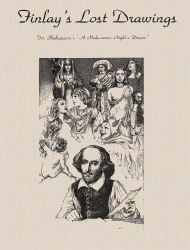
Cover of
Finlay's Lost Drawings
Portfolio |
|
|
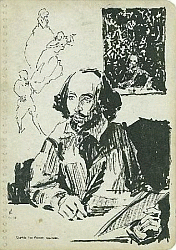
Page 3
of the sketchbook |
|
|
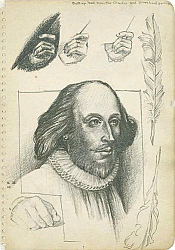
Page 2
of the sketchbook |
|
Virgil Finlay made several sketches of William Shakespeare as studies for 'A Midsummer Night's Dream by Wm. Shakespeare'. The two most detailed sketches are discussed.
The most likely sources for the portraits of William Shakespeare are the so-called:
'Most likely' because there are several portraits that have been claimed to represent Shakespeare, although the identification with Shakespeare is usually debatable.
|
| 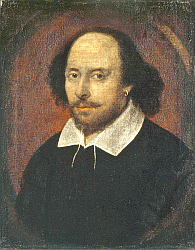
The Chandos portrait |
|
|
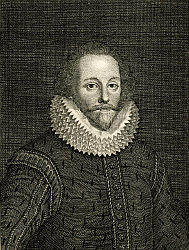
Portrait by S. Bennett Sc. |
|
|
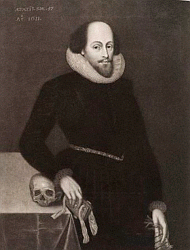
Portrait by G.F. Storm |
|
Comparing the portraits on the cover of the portfolio and on page 3 of the sketchbook one can be fairly certain that the Chandos portrait was the inspiration, as the details are strikingly similar.
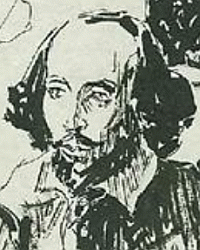
Head on page 3
of the sketchbook |
|
|
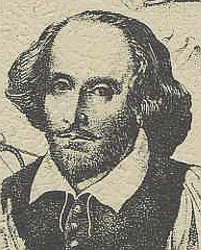
Head on cover of 'Finlay's
Lost Drawings' Portfolio |
|
|
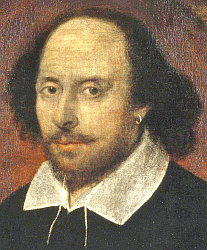
Head on
the Chandos portrait |
|
For the portrait on page 2 of the sketchbook clues to find a potential source are:
- A face that looks to the right from the viewer's perspective, although the use of a mirror image can not be excluded.
- The presence of a ruff, a large round collar of pleated muslin or linen worn by men and women of the late 16th and early 17th centuries.
- The hairdress and the top of the forehead as marked by the hairline.
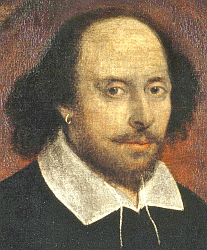
Mirror image of head on
the Chandos portrait |
|
|
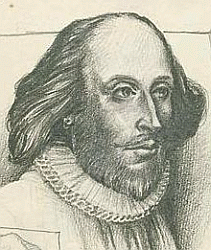
Head on page 2
of the sketchbook |
|
|
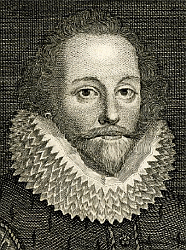
Head by
S. Bennett Sc. |
|
From the portraits that are available for comparison, again, the Chandos portrait, but now as a mirrored image, seems the most likely candidate as details such as the earring, the outline of the hair, and the shadow next to the nostril are strikingly similar.
Portraits of William Shakespeare wearing a ruff are rare. Two such portraits are the portrait after the Harleian miniature by S. Bennett Sc. and published by I. Stockdale on January 1, 1807, and the reproduction in mezzotint by G.F. Storm of the Ashbourne portrait. However, the shape and sizes of the ruffs are very different from the one that is shown in the Virgil Finlay drawing.
Another possible and perhaps more likely source of inpiration for the ruff is the movie 'A Midsummer Night's Dream', directed by Max Reinhardt and William Dieterle. Several characters in the movie wear ruffs, as can be seen in the publicity photo's below.
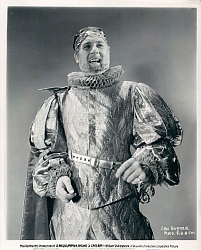
Wire Photo of British Actor Ian Hunter
Theseus, Duke of Athens |
|
|
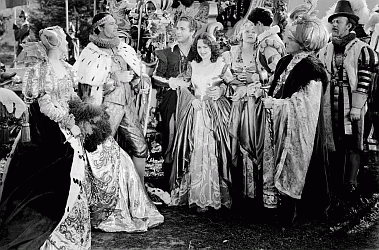
Detail of publicity still
of the movie (1935). |
|
The sketches were made as studies for a book on assigment by Farnsworth Wright. Farnsworth Wright, according to Gerry de la Ree, hoped to capitalise on the then recent movie release of 'A Midsummer Night's Dream'. Given that the movie was released in the USA on October 30, 1935, it is likely that Virgil Finlay worked on the Shakespeare drawings using publicity stills or from memory after seeing the movie.
For now, we conclude that perhaps Virgil Finlay combined the image in the Chandos portrait and the ruffs displayed in the movie to create his own portrait of William Shakespeare.
References on this Site:
References on the internet: